By road
Crossing into Bhutan at Phuentsholing
The Jaigaon–Phuentsholing crossing, hour by hour: what documents you need, where the permit office is, how long it takes and why you should not arrive on a Sunday.

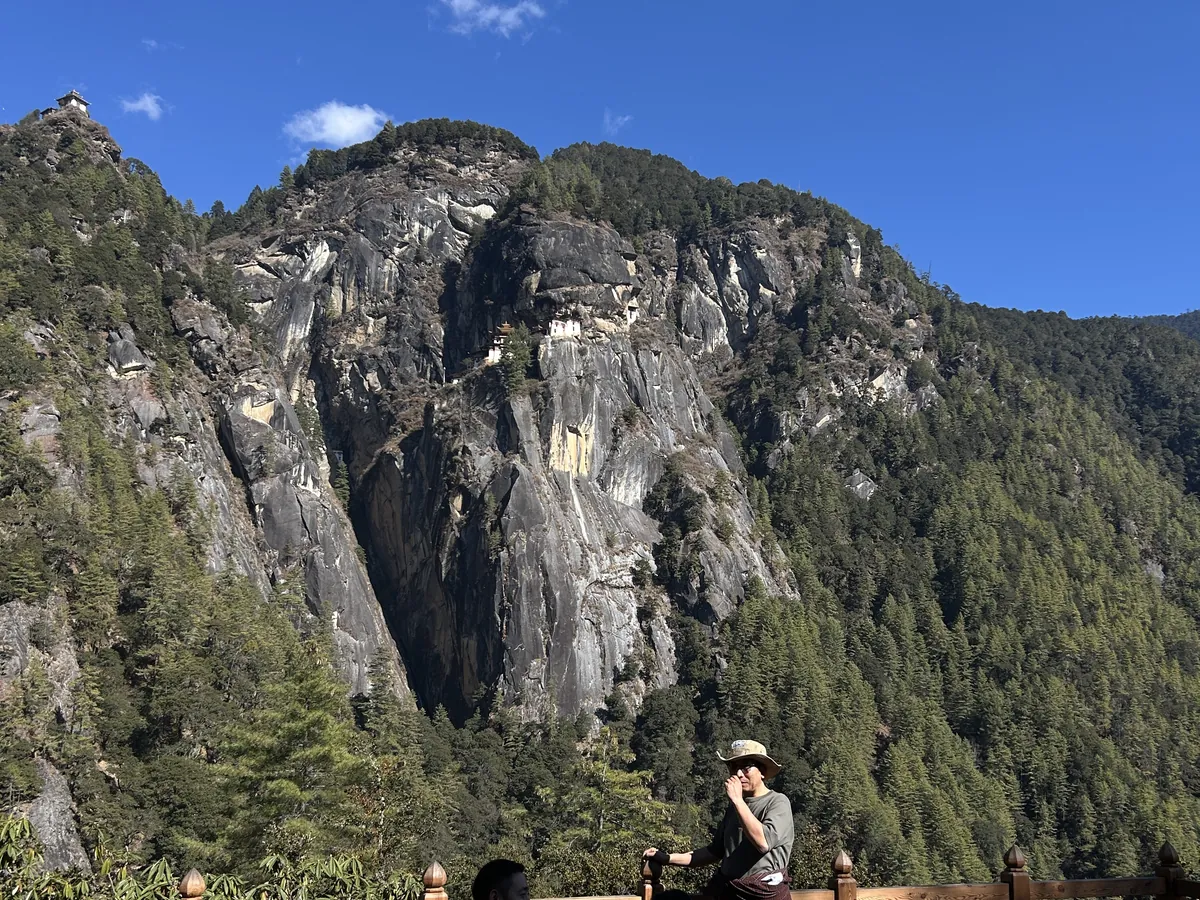
Paro Taktsang sits at about 3,120 m, roughly 900 vertical metres above the valley floor, on a path a little over 4 km each way. Most reasonably fit people take two to three hours up and an hour and a half down, so four to five hours in total plus time inside. It is a steep, sustained walk on dirt and stone — not a climb, and no equipment is needed — but it is the single most physically demanding thing on any standard Bhutan itinerary.
The walk divides into three quite different stretches, and knowing where you are in them makes the whole thing feel shorter.
About an hour and a quarter of steady uphill through blue pine, wide track, no exposure. Horses can be hired for this section and this section only. There is tea and a toilet at the top of it, and the first proper view of the monastery across the gorge.
Another forty-five minutes or so, narrower, with prayer flags and the classic photograph. This is where most people stop for ten minutes and where the altitude starts to be noticeable.
The last stretch drops several hundred steps into the gorge past a waterfall, then climbs an equal number back up to the monastery gate. It is the hardest part and it comes last, which surprises people.
The staircase is the thing to know about in advance. Everything before it is a long walk. The staircase is a leg workout at 3,000 m, and it has to be done twice — down and up on the way in, down and up on the way out.
Leave the hotel at 7am. Two reasons: the path is in shade for the first two hours, which matters more than the temperature suggests, and you are ahead of the coach groups that arrive from 9am onward. The monastery is quieter and the photographs are better.
Bags, cameras and phones are left in lockers at the entrance. Photography is permitted everywhere on the path and outside the buildings, and nowhere inside them. Nobody makes an exception, so there is no point in asking.
Ponies are available at the base and are negotiated on the day, in cash. They carry you as far as the cafeteria and no further — the upper path and the staircase are on foot for everyone, without exception.
They also only go up. Riding down a steep dirt path is worse than walking it, so the horse solves roughly the first third of the ascent and none of the descent. For someone who is fit but slow it can be the difference between finishing and turning back. For someone who genuinely cannot manage 900 m of stairs and gradient, it is not a solution, and we would rather say so than sell it.
The viewpoint before the staircase is a perfectly good destination and the view from it is the one on every postcard. Walking to the cafeteria, having tea and turning round is also a fine morning. We build Taktsang as the last full day of most itineraries precisely so that nobody has to hike it on day two with the altitude still unfamiliar.
Nothing about Taktsang is technical, but the combination of sustained gradient, hundreds of steps and 3,000 m of altitude is real.
Done sensibly it is the best day of the trip. Done on four hours of sleep, in new shoes, with a flight to catch that afternoon, it is the worst.
Written by the Evergreen Travels team · published
It is a sustained uphill walk of about 900 vertical metres over roughly 4 km each way, finishing with several hundred steps down into a gorge and back up. No technical skill or equipment is needed, but it takes four to five hours return and is the most demanding part of a standard Bhutan itinerary.
Two to three hours up and about an hour and a half down for most people, plus twenty to forty minutes inside the monastery. Start at 7am to walk in shade and stay ahead of the groups.
A pony will carry you as far as the halfway cafeteria, uphill only. The upper path and the final staircase must be walked by everyone. Ponies are hired at the base on the day and paid in cash.
Children from around eight years old usually manage it comfortably, often faster than the adults. For younger children, plan on one adult turning back at the cafeteria or the viewpoint, both of which are good destinations in themselves.
Yes on the path and outside the buildings, no inside them. Phones, cameras and bags are left in lockers at the monastery entrance, and the rule is applied to everyone.
The Jaigaon–Phuentsholing crossing, hour by hour: what documents you need, where the permit office is, how long it takes and why you should not arrive on a Sunday.
Paro, Thimphu, Punakha, Jakar and Wangdue tshechus compared: when each falls, how big it is, how hard the hotels are to get and which one suits a first visit.
Bhutan as a multi-generation trip: the drives, the altitude, what children actually enjoy, and where to slow down for older travellers.
Indian, Bangladeshi and Maldivian nationals need a permit, not a visa. What documents to carry, where it is issued, what the SDF costs and how long it takes.
October and November give the clearest mountain views, March to May the rhododendron and the big tshechus. Month-by-month weather, festivals and trade-offs.
Ngultrum is pegged 1:1 to the rupee and INR is accepted widely. Where cards work, which notes get refused, where the ATMs are and how much cash to carry.
Tell us the dates and who is coming. We will send back a route that fits, not a brochure.
Talk to a Bhutan specialist →