By road
Crossing into Bhutan at Phuentsholing
The Jaigaon–Phuentsholing crossing, hour by hour: what documents you need, where the permit office is, how long it takes and why you should not arrive on a Sunday.

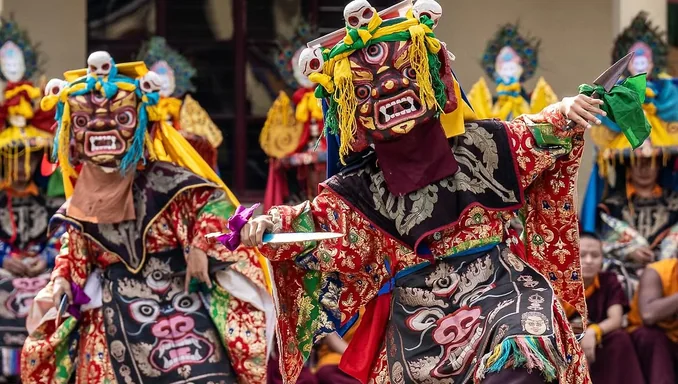
A tshechu is a multi-day religious festival of masked cham dances held in a dzong courtyard. The dates move every year because they follow the Bhutanese lunar calendar, and they are announced roughly a year ahead. Paro (spring) and Thimphu (autumn) are the largest and the hardest to get hotels for; Jakar, Wangdue, Gangtey and Haa are smaller, far less crowded and, for most travellers, the better experience.
A tshechu honours Guru Rinpoche and runs for three to five days in the courtyard of a dzong or a monastery. Monks and trained laymen perform cham — masked dances that are liturgy rather than theatre, each one telling a specific story about the subjugation of a demon or the judgement of the dead. Between them, atsaras, the red-masked clowns, work the crowd and keep the day from becoming solemn.
It is also the biggest social event of the year in that valley. Families come in their best kira and gho, eat on the grass, and stay the whole day. You are a guest at a religious occasion that is not staged for visitors, which is exactly why it is worth building a trip around.
The largest tshechus end at dawn on the final day with the unfurling of a thongdrel — an appliqué silk scroll several storeys high, hung against the dzong wall and rolled away before the sun can touch it. Seeing one means being in the courtyard by about 4am. It is the single most extraordinary thing on the Bhutanese calendar and it is over by breakfast.
| Festival | Roughly when | Scale | Suits |
|---|---|---|---|
| Paro Tshechu | March or April | Very large | First visit; rhododendron season; combines with Taktsang |
| Thimphu Tshechu | September or October | Largest of all | Spectacle and clear autumn weather; book a year out |
| Punakha Drubchen & Tshechu | February or March | Large | The re-enacted battle procession; warm valley in winter |
| Wangdue Tshechu | September or October | Medium | Near Punakha, far calmer than Thimphu the same week |
| Jakar Tshechu | October or November | Medium | Bumthang; the most traditional in feel, fewest outsiders |
| Gangtey Tshechu | September or October | Small | Phobjikha; can be paired with the cranes in late autumn |
| Haa Summer Festival | July | Small, secular | Nomad culture and food rather than cham; monsoon caveat |
Dates are fixed to the lunar calendar and confirmed by the Tourism Council roughly a year in advance, so a festival trip is planned around a date we look up, not a month you guess. Tell us which festival matters to you and we will build the itinerary around it rather than hoping it lands.
Paro and Thimphu during their own tshechus are the two hardest weeks of the year to accommodate. The valley has a finite number of rooms, half of them are held by operators from the previous year, and prices go up. Booking four to six months out is normal; booking eight to twelve months out for Thimphu is sensible.
There are two good ways around it, and we use both:
Go for one full day rather than two half days. The structure of a tshechu builds through the day, and leaving at noon means missing the point of it.
Written by the Evergreen Travels team · published
It falls in March or April, on dates set by the Bhutanese lunar calendar, so it moves every year and is confirmed about a year in advance. Tell us the year you plan to travel and we will give you the confirmed dates.
A tshechu is a religious festival held over three to five days in a dzong courtyard, honouring Guru Rinpoche through masked cham dances performed by monks and trained laymen. It is a genuine religious occasion rather than a performance for visitors, and it is also the biggest social gathering of the year in that valley.
Paro in spring, because it is large enough to be spectacular and sits in the same valley as the Tiger’s Nest, or one of the smaller autumn tshechus such as Wangdue, Gangtey or Jakar if you would rather not be in a crowd. Thimphu is the biggest and by far the hardest to find hotels for.
Four to six months for most tshechus, and eight to twelve months for Thimphu or Paro during their own festival weeks. Hotel availability, not the permit, is the binding constraint.
Yes, and visitors are welcome. Dress as you would for a temple, keep off the dance floor, do not photograph the interiors of temple buildings, and do not block the Bhutanese families who arrived at dawn.
The Jaigaon–Phuentsholing crossing, hour by hour: what documents you need, where the permit office is, how long it takes and why you should not arrive on a Sunday.
Taktsang is a 900 m ascent over 4 km each way, four to five hours return. What the path is like, where the hard part is, and when to start.
Bhutan as a multi-generation trip: the drives, the altitude, what children actually enjoy, and where to slow down for older travellers.
Indian, Bangladeshi and Maldivian nationals need a permit, not a visa. What documents to carry, where it is issued, what the SDF costs and how long it takes.
October and November give the clearest mountain views, March to May the rhododendron and the big tshechus. Month-by-month weather, festivals and trade-offs.
Ngultrum is pegged 1:1 to the rupee and INR is accepted widely. Where cards work, which notes get refused, where the ATMs are and how much cash to carry.
Tell us the dates and who is coming. We will send back a route that fits, not a brochure.
Talk to a Bhutan specialist →