By road
Crossing into Bhutan at Phuentsholing
The Jaigaon–Phuentsholing crossing, hour by hour: what documents you need, where the permit office is, how long it takes and why you should not arrive on a Sunday.

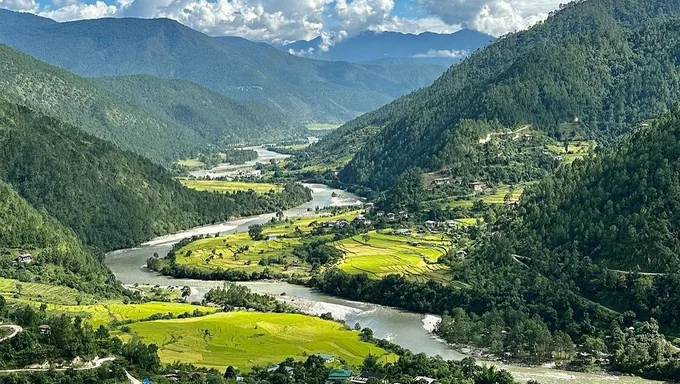
Bhutan is one of the easiest Himalayan countries to take a family to: no visa for Indians, private vehicles throughout, very low crime, and nothing on a standard itinerary above 3,100 m except a day trip. The two things that decide whether it works are the length of the drives and how honest you are about the Tiger’s Nest. Seven days with Punakha as the low-altitude base is the shape that suits most families.
Punakha sits at 1,200 m, Paro at 2,200 m and Thimphu at 2,320 m. None of that troubles children or healthy older adults. Phobjikha at 3,000 m and Dochula at 3,100 m are the high points of a normal route, and Dochula is a forty-five minute stop rather than a night.
What people underestimate is the driving. Bhutan has one main east–west highway and it bends continuously. Thimphu to Punakha is 2 hours 30 minutes for 75 km. Anyone in the family who is prone to motion sickness will find out on the Dochula descent, so bring what works for them and sit them in the front.
No more than one long driving day in a row, and never a long drive on the day after arrival. It sounds obvious. It is the single most common reason a family trip feels rushed.
Dzongs are magnificent and, for an eight-year-old, three of them in four days is two too many. The things that reliably work:
Food is rarely a problem. Every hotel cooks Indian food competently, and the Bhutanese national dish is chillies cooked in cheese, so children generally eat around it happily.
Bhutan suits older travellers better than most Himalayan destinations, because the sights are reached by road and the walking is optional almost everywhere. Two adjustments make it comfortable:
The Tiger’s Nest is a 900 m ascent and several hundred steps. Some seventy-year-olds walk it comfortably and some forty-year-olds do not. Decide as a family before the trip, not at the trailhead at 7am — we build the Taktsang day so that whoever is not climbing has a full Paro day of their own: the museum, Kyichu Lhakhang, the town, and a long lunch. Nobody sits in a hotel room.
| Day | Where | Why it is placed there |
|---|---|---|
| 1 | Phuentsholing | Cross in the morning, permits done, short first day |
| 2 | Thimphu | Climb up from the plains; afternoon at the Buddha and the takin preserve |
| 3 | Thimphu | Route permits, archery, an easy day to settle at altitude |
| 4 | Punakha via Dochula | The chortens, then down to 1,200 m and the suspension bridge |
| 5 | Punakha | Rice terraces, the temple in the fields, a farmhouse lunch |
| 6 | Paro | Drive over, museum and dzong in the afternoon |
| 7 | Paro | Taktsang for whoever is climbing; a full Paro day for whoever is not |
Five days can be made to work if you fly into Paro and skip the border drive. Below that, you are spending the holiday in a car.
Written by the Evergreen Travels team · published
Yes. There is no visa for Indian nationals, transport is private throughout, crime is very low and nothing on a standard route is high-altitude. The limiting factors are the winding roads and the Tiger’s Nest climb, both of which can be planned around.
Rarely. Thimphu is 2,320 m, Punakha only 1,200 m, and the highest points on a normal itinerary — Dochula at 3,100 m and Chele La at 3,988 m — are day stops, not overnight stays. Drink plenty of water on the first two days and avoid alcohol before a pass.
The Punakha suspension bridge, archery, the takin preserve in Thimphu, the Buddha Dordenma, turning prayer wheels, and a farmhouse lunch with a hot-stone bath. Dzongs are magnificent but two or three is plenty for younger children.
Seven is comfortable by road, with two nights in Punakha at low altitude. Five works if you fly into Paro and skip the border drive. Anything shorter turns the holiday into a driving schedule.
We build the Taktsang day so that anyone not climbing has a full Paro programme instead — the National Museum, Kyichu Lhakhang and the town. The viewpoint partway up and the halfway cafeteria are also perfectly good destinations on their own.
The Jaigaon–Phuentsholing crossing, hour by hour: what documents you need, where the permit office is, how long it takes and why you should not arrive on a Sunday.
Taktsang is a 900 m ascent over 4 km each way, four to five hours return. What the path is like, where the hard part is, and when to start.
Paro, Thimphu, Punakha, Jakar and Wangdue tshechus compared: when each falls, how big it is, how hard the hotels are to get and which one suits a first visit.
Indian, Bangladeshi and Maldivian nationals need a permit, not a visa. What documents to carry, where it is issued, what the SDF costs and how long it takes.
October and November give the clearest mountain views, March to May the rhododendron and the big tshechus. Month-by-month weather, festivals and trade-offs.
Ngultrum is pegged 1:1 to the rupee and INR is accepted widely. Where cards work, which notes get refused, where the ATMs are and how much cash to carry.
Tell us the dates and who is coming. We will send back a route that fits, not a brochure.
Talk to a Bhutan specialist →