By road
Crossing into Bhutan at Phuentsholing
The Jaigaon–Phuentsholing crossing, hour by hour: what documents you need, where the permit office is, how long it takes and why you should not arrive on a Sunday.

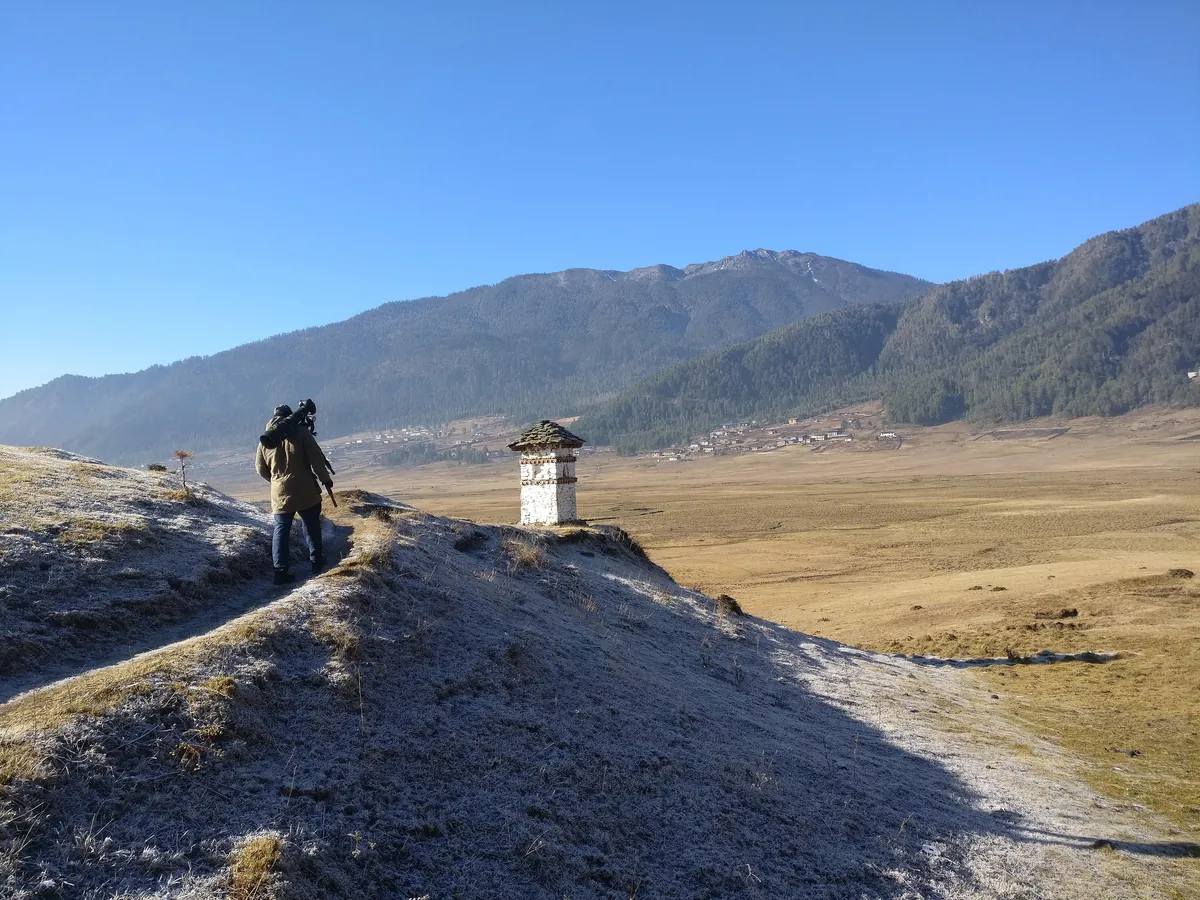
Black-necked cranes winter in the Phobjikha valley at 3,000 m from late October to mid-February, with the largest numbers between November and January. The best viewing is from the Royal Society for Protection of Nature centre at the valley edge, which has scopes and a hide, in the first two hours after sunrise or the last two before dusk. The Crane Festival is held at Gangtey Goenpa on 11 November each year.
The black-necked crane breeds on the Tibetan plateau and crosses the Himalaya to winter in a handful of valleys, of which Phobjikha is the most important in Bhutan. Several hundred birds arrive from the last week of October, feed on the marshy valley floor through the winter, and leave again in February. The valley is a glacial bowl — wide, flat, treeless in the middle and ringed with blue pine — which is exactly what they want.
They arrive by circling Gangtey Goenpa, the monastery on the hill at the head of the valley, three times before landing, and they circle it three times again on leaving. Everyone in Phobjikha will tell you this and, as far as anyone can establish, it is perfectly true.
Phobjikha had no mains electricity until 2010, and when it came, the lines were laid underground at considerable expense so that overhead cables would not kill the cranes. It is the clearest single illustration of how Bhutan makes decisions, and it is worth knowing while you are standing there.
| Month | Birds present | Notes |
|---|---|---|
| Late October | First arrivals | Numbers still building; autumn colour in the valley |
| November | Most of the flock | Crane Festival on the 11th at Gangtey Goenpa; the best all-round month |
| December–January | Peak numbers | Coldest — around −7°C at night — and the clearest skies of the year |
| Early February | Departing | Numbers thinning; they are gone by the end of the month |
| March–September | None | The valley is beautiful and empty of cranes |
Time of day matters as much as the month. The birds feed on the valley floor early and late and are dispersed and distant in the middle of the day. Be at the centre by sunrise, or from about an hour before dusk. This means sleeping in Phobjikha rather than driving over from Punakha for the afternoon — a day trip is the most common way people miss them.
The RSPN Crane Information Centre sits on the northern edge of the valley floor with a hide, mounted spotting scopes, a small exhibition and large windows. There is a modest entry fee, it opens early, and the staff will tell you where the birds were that morning.
The Gangtey Nature Trail is the other reason to stay the night: an easy, downhill, ninety-minute walk from the monastery through pine and past farmhouses to the valley floor. It is the best short walk in western Bhutan and it puts you on the marsh edge at the right time of the afternoon anyway.
Stay on the paths and the bunds, keep dogs away, and do not walk out onto the marsh to get closer. The flock is a few hundred birds out of a world population in the low thousands, and the whole valley has organised itself around not disturbing them.
Phobjikha is about three hours beyond Punakha on the road east, and it is a dead end unless you are continuing to Bumthang. That means two extra travelling half-days on a western-circuit trip, which is why short itineraries skip it.
If you are coming for the cranes, build a nine-day route and give the valley two nights: arrive in the afternoon, walk the nature trail, be at the hide at dawn, and drive back to Punakha or on to Trongsa after breakfast on the second day. Combining it with the Gangtey Tshechu in autumn or the Crane Festival on 11 November gets you two reasons for the same detour.
Written by the Evergreen Travels team · published
From the last week of October to mid-February in the Phobjikha valley, with peak numbers between November and January. They breed on the Tibetan plateau and return there in spring.
The Royal Society for Protection of Nature Crane Information Centre on the northern edge of the valley floor, which has a hide, spotting scopes and an exhibition. Go in the first two hours after sunrise or the last two before dusk, when the birds feed close in.
It is held on 11 November each year in the courtyard of Gangtey Goenpa, with masked dances, schoolchildren performing crane dances and stalls from the valley. Unlike a tshechu, the date does not move.
Around −7°C at night in December and January, at 3,000 m, and cold enough before sunrise that most visitors underestimate it. Days are bright and clear. Bring a proper down layer, gloves and a hat.
Two, if the cranes are the reason you are going. That gives you an afternoon on the Gangtey Nature Trail and a dawn at the hide. A day trip from Punakha usually arrives in the middle of the day, when the birds are dispersed and far off.
The Jaigaon–Phuentsholing crossing, hour by hour: what documents you need, where the permit office is, how long it takes and why you should not arrive on a Sunday.
Taktsang is a 900 m ascent over 4 km each way, four to five hours return. What the path is like, where the hard part is, and when to start.
Paro, Thimphu, Punakha, Jakar and Wangdue tshechus compared: when each falls, how big it is, how hard the hotels are to get and which one suits a first visit.
Indian, Bangladeshi and Maldivian nationals need a permit, not a visa. What documents to carry, where it is issued, what the SDF costs and how long it takes.
October and November give the clearest mountain views, March to May the rhododendron and the big tshechus. Month-by-month weather, festivals and trade-offs.
Ngultrum is pegged 1:1 to the rupee and INR is accepted widely. Where cards work, which notes get refused, where the ATMs are and how much cash to carry.
Tell us the dates and who is coming. We will send back a route that fits, not a brochure.
Talk to a Bhutan specialist →