By road
Crossing into Bhutan at Phuentsholing
The Jaigaon–Phuentsholing crossing, hour by hour: what documents you need, where the permit office is, how long it takes and why you should not arrive on a Sunday.

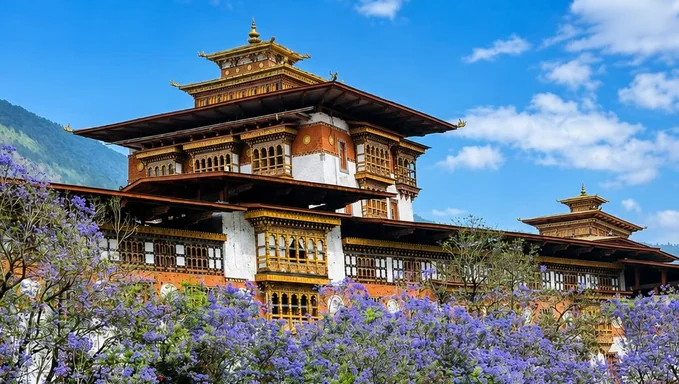
For a honeymoon, spend your nights in Punakha and Paro and treat Thimphu as a stop rather than a stay. Six to seven days is the right length. March to May and October to early December are the months worth paying for — jacaranda over Punakha Dzong in spring, and the sharpest mountain air of the year in autumn.
Punakha is the warm one. At 1,200 m it stays mild when Thimphu is freezing, the valley floor is rice terraces rather than town, and Punakha Dzong — on the spit of land where the Pho Chhu and Mo Chhu meet — is the most beautiful building in Bhutan by a distance. In April and May the jacarandas along its walls come into flower and it stops being a building and becomes a photograph.
Two nights lets you have an unhurried second day: the walk up through the rice fields to Khamsum Yulley Namgyal Chorten, the suspension bridge, an afternoon by the river, dinner somewhere that is not a hotel buffet. One night makes it a stop between two drives.
Thimphu is the capital and has the country’s only traffic and its only nightlife worth the name, which is not usually what people came for. See Tashichho Dzong and the Buddha Dordenma, buy what you want to buy, and sleep somewhere quieter.
| Window | What you get | What it costs you |
|---|---|---|
| March–May | Rhododendron, jacaranda at Punakha, warm valleys, Paro Tshechu | Peak rates, and afternoon haze can soften the mountain views |
| October–early December | The clearest air of the year, big festivals, cold bright mornings | The busiest weeks in the country; book far ahead |
| December–February | Empty temples, sharp Dochula views, low rates, Punakha stays mild | Cold at night; passes can close for a morning |
| June–September | Green, quiet, cheap, dramatic cloud | Monsoon; Paro flights are the most delay-prone and Taktsang can be slick |
If the mountains matter to you more than the flowers, come in late October. If the photographs matter more than the skyline, come in April.
The itinerary is the easy part. What people remember is four or five small things, and they all have to be arranged in advance:
We do not publish prices for any of this, and anything above is arranged as part of the itinerary rather than sold as an add-on at the door.
Fly into Paro if the budget allows and the drive home matters to you; come by road through Phuentsholing if you would rather spend the money on where you sleep. Both work, and the difference is roughly a day at each end.
Written by the Evergreen Travels team · published
Yes, particularly for couples who want quiet, scenery and privacy rather than nightlife. Punakha and Paro are the two valleys worth spending nights in, six to seven days is the right length, and the best months are March to May and October to early December.
Six or seven. That allows two nights in Punakha, three in Paro including the Tiger’s Nest, and one in Thimphu, without a long drive on consecutive days.
Punakha. It sits at 1,200 m so it is warm year-round, the valley floor is rice terrace rather than town, and Punakha Dzong between two rivers — with jacaranda in flower in April and May — is the most beautiful building in the country.
A traditional Bhutanese bath in a wooden tub, heated by river stones taken glowing from a fire and dropped into a separate compartment, usually with artemisia leaves in the water. It is arranged at farmhouses, typically after dinner, and needs to be booked ahead.
Late April into May in most years. It is the single best photographic window at the dzong, and it coincides with warm weather in the valley and rhododendron higher up.
The Jaigaon–Phuentsholing crossing, hour by hour: what documents you need, where the permit office is, how long it takes and why you should not arrive on a Sunday.
Taktsang is a 900 m ascent over 4 km each way, four to five hours return. What the path is like, where the hard part is, and when to start.
Paro, Thimphu, Punakha, Jakar and Wangdue tshechus compared: when each falls, how big it is, how hard the hotels are to get and which one suits a first visit.
Indian, Bangladeshi and Maldivian nationals need a permit, not a visa. What documents to carry, where it is issued, what the SDF costs and how long it takes.
October and November give the clearest mountain views, March to May the rhododendron and the big tshechus. Month-by-month weather, festivals and trade-offs.
Ngultrum is pegged 1:1 to the rupee and INR is accepted widely. Where cards work, which notes get refused, where the ATMs are and how much cash to carry.
Tell us the dates and who is coming. We will send back a route that fits, not a brochure.
Talk to a Bhutan specialist →